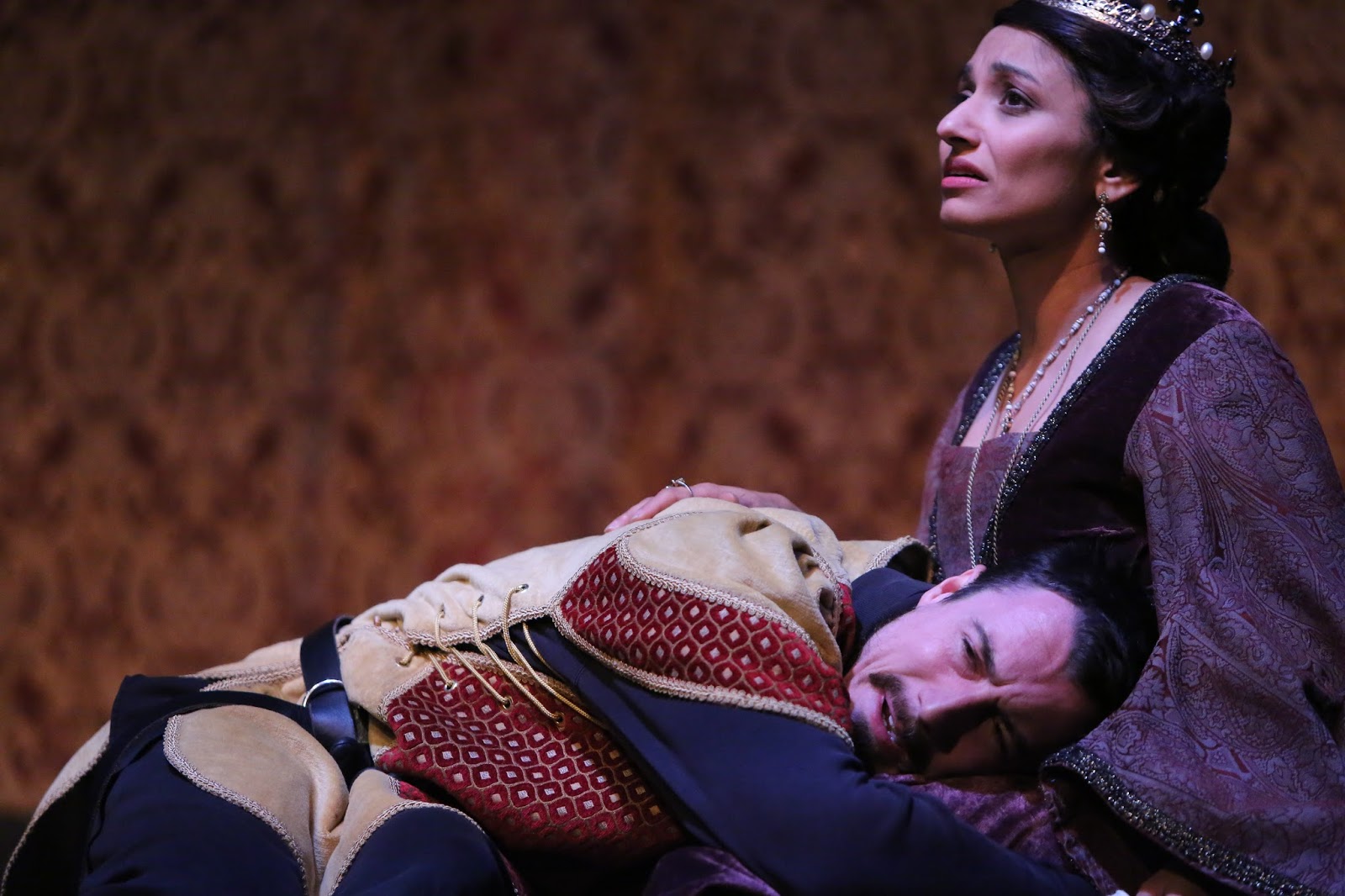
Friday, November 18, 2016

Shakespeare: Dramatist, Not Historian. By Samantha Smith

The three plays that comprise Henry VI are classified as histories, but they were never intended to be precise accounts of historical events.  These plays were not historically accurate biopics but large-scale entertainment meant to amuse, captivate, and inspire audiences with scenes of valor, cunning, passion, humor, and English patriotism.  Shakespeare drew heavily on the historical chronicles written by Edward Hall and Raphael Holinshed as sources, and he did accurately depict some historical events in Henry VI.  However, he frequently deviated from history when it suited his needs as a dramatist, omitting historical facts, condensing timelines, inventing characters, and embellishing historical incidents.

from http://www.warsoftheroses.com/henryvi.cfm
Shakespeare’s decision not to incorporate the historical Henry VI’s bouts of extreme mental illness into the plays bearing his name had a profound effect on the narrative of Henry VI.  The historical Henry VI was so incapacitated by illness that other government officials, including the Lord Protector, were forced to completely take over ruling the kingdom several times during his reign.  The tenor of the plays of Henry VI would be very different if Shakespeare had included depictions of Henry’s illness.  

Instead, Shakespeare’s illustration of Henry as an incredibly pious, virtuous man who perhaps lacked the forcefulness required to navigate court intrigue and defend his crown, fit more with popular perceptions of Henry VI, who was revered and respected for his piety.  King Henry VII unsuccessfully attempted to have Henry VI canonized as a saint, and a popular cult developed around Henry VI during Henry VII’s reign.  Public regard for Henry VI steadily grew after his death, and Shakespeare’s depiction of the pious king would have appealed to many of his sixteenth-century audience members.

Henry VI, Part One provides a multitude of examples small and large of Shakespeare altering or adding to historical facts.  While we don’t have any personal writings in which Shakespeare explained his thought process, scholars have posited why Shakespeare might have been inclined to stray from historical details.  Sometimes Shakespeare changed historical facts because they were not crucial to the plot.  For example, the list of French towns that the English messenger says have been lost in the beginning of the play are historically incorrect but the intended effect of demonstrating that the English are losing the land that Henry VI’s father famously won in France remains.  Shakespeare invented new, fictitious characters like the Countess of Auvergne, whose attempt to imprison Talbot in her castle provides a moment of levity in the play and reinforces Talbot’s power in France.  

Shakespeare greatly condensed historical events to create a play that covers decades of history in three hours; for example, Joan of Arc convinces the Duke of Burgundy to defect from the English in one scene in Act Three, whereas in reality his defection took place four years after her death and was the result of ten years of negotiations between him and the French nobles.  Shakespeare also relied on biased depictions of historical figures when he knew it would appeal to his audience; his portrayal of Joan of Arc as a conniving sorceress catered to a very pro-English, anti-French audience.  

Shakespeare changed historical details to create scenes with higher stakes and dramatic intensity; whereas the historical John Talbot was one of Talbot’s several sons and was a grown man with children, Shakespeare’s John Talbot is Talbot’s sole son, and he is young and unmarried, making his death and the subsequent end of the Talbot bloodline more poignant. 

Shakespeare continued the trend of choosing historical accuracy when it fit his needs as a dramatist in Part Two and Part Three of Henry VI.  Shakespeare overlapped historical figures who did not meet in real life to create tension; the shared dislike between Margaret and Eleanor is historically inaccurate because Eleanor’s disgrace and downfall happened four years before Margaret came to the English court.  Shakespeare established Margaret as a powerful, forceful woman at court immediately after her marriage, having her collude with Suffolk to bring down Gloucester and having her fight for power on Henry’s behalf, whereas the historical Margaret was only fifteen and relatively politically inexperienced when she married Henry, and she did not immediately get involved in power plays at the court.  The affair between Suffolk and Margaret was largely Shakespeare’s invention after he expanded on historical hints of Suffolk’s interest in Margaret.  

Shakespeare invented York’s involvement in the Cade rebellion, and he drew more on the Peasant’s Revolt than the historical Cade rebellion in his depiction of the rebels, who, in reality, were reasonably educated middle- and upper-class artisans.  At the end of Part Two, Shakespeare incorporated the Duke of York’s son, Richard, into the battle, although the historical Richard was only two when the battle of Saint Albans took place.  That was not the only time Shakespeare changed a character’s age in Henry VI; in Part Three, he decreased the age of York’s youngest son, Rutland, which made his murder by Clifford more shocking.


These are just a few examples of Shakespeare’s changes to history in Henry VI.  For more information, check out Peter Saccio’s book Shakespeare’s English Kings: History, Chronicle, and Drama, from which the examples of Shakespeare’s adherence to and deviation from the historical record in Henry VI listed in this blog were taken.  For more information about Henry VI’s legacy, look into David Grummitt’s book, Henry VI. 

Tuesday, November 15, 2016

Come See Henry VI By Samantha Smith


For the past several months, our theatre has been filled with the sound of words that are about 425 years old as our company worked to rehearse and perform all three parts of Henry VI.  I have looked on with admiration as the director, Jeff Watkins, and the cast worked ever diligently, filling the building with the sounds of their efforts.  York’s railings against the crown greeted me as I came to work and Henry’s lamentations reverberated around me as I left.  Trumpets sounded every morning and swords clashed every afternoon as fight choreographers created battles and actors practiced them.  And more than once, when I waited for a battle to finish so I could walk through the theatre, I pondered why these plays, sometimes criticized, often overlooked, and rarely performed, are still so compelling after four centuries. 

We all know that Shakespeare grew into one of the greatest dramatists the world has ever seen, and so it is fascinating to look on the three parts of Henry VI, the earliest history plays he wrote, and see glimpses of rhetorical features that became staples of his later, more famous historical plays, like the two parts of Henry IV and Henry V.  As he did in writing his other history plays, Shakespeare relied heavily on source materials like the historical chronicles written by Hall and Holinshed while crafting the three parts of Henry VI.  However, he showed his inclination to deviate from his sources and the historical narrative, making alterations that condensed great swaths of English history into plays that could be performed in three hours and making changes to historical fact to create more emotionally moving scenes and more compelling characters.  

Through the conversation between Talbot and his son before they die in Part One, the moment Suffolk and Margaret share before he leaves England in Part Two, and the time Henry muses on his longing for a simpler life in Part Three, Shakespeare demonstrated his gift for creating deeply moving, if historically unfounded, scenes.  Through the depictions of pious Henry, ambitious York, and vengeful Richard, Shakespeare captured a spectrum of humanity and raised questions about duty to God, country, and family.  Scholars rightly argue that Shakespeare’s most nuanced work and best writing came after Henry VI, but the compelling narrative Shakespeare created in these three plays is a testament to his early talent.  


Ultimately, Shakespeare revealed in Henry VI his ability to create exciting entertainment that captivates modern audiences as much as it did Elizabethan spectators.  With ambitious usurpers, family squabbles, court intrigue, broken allegiances, love affairs, murder, riots, witches, pirates, battles, and heads on pikes, the three parts of Henry VI are basically Game of Thrones with more poetry.  So pick a side, Lancaster or York, red rose or white, and join us as the Wars of the Roses play out at the Shakespeare Tavern Playhouse for the next two weekends. 

Tuesday, October 25, 2016

How Shakespeare Wrote for a Royal Audience in Macbeth

Like so many admonitions given to young writers, “write for your audience” held true long before the phrase gained popularity in freshman composition classrooms.  Writers have always known that for a work to be moving, let alone commercially successful, the syntax, word choice, and subject of the piece should appeal to the particular audience for which it is intended. 

Shakespeare excelled at knowing and writing for diverse audiences that included apple sellers, merchants, nobility, and royalty.  Shakespeare’s appeal to so many distinct groups stemmed from his judicious choices in composition, creating characters of all socioeconomic levels, employing humor ranging from bawdy and scatological to esoteric, and featuring widely popular themes of patriotism and a national sense of superiority to England’s neighbors.  Scholars sometimes highlight Macbeth’s line “No, this my hand will rather/The multitudinous seas incarnadine,/Making the green one red” (2.3.59-61) as an example of how Shakespeare paid attention to the varied educational backgrounds of his audience by innovatively using the adjective “incarnadine” as a verb, shortly followed by an illustration of what an incarnadine sea would look like. 
King James I
Queen Elizabeth I


One of the most important audience members who saw Macbeth was King James I, the successor of Shakespeare’s former patron and monarch, Queen Elizabeth.  Scholars believe that Shakespeare took into account King James’ fears about assassination, his pride in his lineage, and his interest in witchcraft when writing Macbeth.  The play’s focus on assassinating a King dealt with one of King James’ main fears and a topical concern for the nation just a year after Guy Fawkes was thwarted in his plan to blow up King James and all of parliament in 1605.  The trauma of seeing Duncan’s regicide would have been lessened for King James by the play’s emphasis on the downfall of Macbeth, Duncan’s assassin, and the restoration of Malcolm to the Scottish throne.  King James traced his heritage to Banquo and his son Fleance, who escapes the murderers that Macbeth sends to kill him, and scholars suggest that Shakespeare emphasized Banquo’s virtue compared to Macbeth’s treachery as a compliment to the King, who saw Macbeth at his court.  

Scholars also posit that Shakespeare’s inclusion and portrayal of the witches was influenced by King James’ interest in witchcraft.  Beyond believing that witches sought to harm him at various times throughout his life, King James also wrote a book called Of Demonology, in which he asserted that witches were women who had masculine features who cursed people through their conjuring.  Banquo describes the witches in terms similar to King James’ depiction: “you should be women,/And yet your beards forbid met to interpret/That you are so” (1.3.42-44).  Shakespeare’s incorporation of elements intended to appeal to King James demonstrates his skill in writing for a royal audience.  

Submitted by Samantha Smith

Friday, September 30, 2016

Thoughts on Henry VI By Mary Ruth Ralston

I’ve spent the last several days muddling over what I want to say about Shakespeare’s Henry VI and the experience of playing him. There’s a lot to talk about. Although the play isn’t wall-to-wall earth-shaking verse like some of Shakespeare’s later works, it’s full to the gills with complex characters, nuanced political intrigue, and a haunting sense of national soul-searching. This story brings up a lot of tough questions with which we still grapple:
Can a warlike country call itself Christian? Does a leader have to sacrifice being a good person in order to be a good leader? Is kindness a weakness? Is cruelty a strength? Is it better to obey our leaders or our own consciences when they tell us different things? How do we define masculinity and femininity, and what do we do to ourselves when we try to enforce those definitions?

Those questions only scratch the surface, and I could geek out for hours about this play and the issues it raises. If you want to catch me in the lobby after a show and chat about it, I’m most likely up for a chat. But for this post I want to narrow it down. I asked myself the other day what I would say to a child who had seen these plays and asked me afterwards what they were about and why I wanted to play Henry. This is a tough story to present to children, and there have been a few in the audience, so I wanted to have my answers ready for them. This story is dark and sad. Over the course of these three plays we watch a kind, generous, trusting person be manipulated and used, fail to prevent his country from falling into chaos and war, and eventually [SPOILERS] die alone, ashamed, and heartbroken at the hands of a triumphant sociopath.

So for the kids out there, this is what I think the story of this sad, sweet, eventually powerless man can tell us.

Firstly, about Henry himself: I don’t think Shakespeare intends for us to leave believing that all of Henry’s defining qualities are weaknesses. It’s easy to dismiss him as just a spineless wimp who lost his throne because he lacked the strength of will to keep it, and his inaction and self-doubt are certainly a big part of the story. But Henry also has immense strength. He has a deep, quiet moral strength that he never ever loses, no matter how much other people use and belittle him. Henry, in spite of everything that happens around him, never becomes cruel or callous or petty. Henry remains honest and empathetic; he loves his family and his subjects even when they let him down. Henry [SPOILERS] uses his literal last breath to pray for his murderer. To me, that speaks of incredible internal strength that is worthy of admiration, and much of the tragedy in the play is in knowing that Henry could have been a great king if the people around him rather than preying on his weaknesses had worked to magnify his strengths. Being able to play that soulful strength and that unfailing moral compass even in the midst of so much doubt and grief and frailty and collapse makes Henry a remarkably rewarding part to act.

Secondly, about Henry’s world: I think the main reason Henry’s England falls apart to such a terrible degree can be summed up pretty nicely by the Two Wolves fable. The story is that there are two wolves fighting inside of all of us. One wolf is kindness and empathy. The other is cruelty and selfishness. Which wolf wins in the end depends entirely on which one we feed most. I like to think of Henry and Richard as England’s two wolves, and over the course of three plays we watch England and its nobility feed the wrong wolf until at the end of Part III we finally see the two wolves face off; Henry, the kind wolf, is spiritually starved and weakened to the point that he’s barely there while Richard, the cruel wolf, is strong and well-fed and [SPOILERS] able to destroy the kind wolf with ease and gusto, leaving the world for himself to bustle in. The reason this happens isn’t just because Henry failed as a leader. It’s also because the followers in whom Henry put his trust failed to be the virtuous people their king believed they could be.

I think, then, the reason that it’s important to tell this story is for this painful truth: the kind wolf can’t win if we don’t make the constant effort to feed it more. One person trying to be good and do the right thing is not enough. They have weaknesses, and if we expect them to their fight alone they will lose, and the cruel, manipulative, selfish wolf will win. This isn’t a very comforting moral (especially considering how much food is available to the cruel wolf) but we have ample evidence of its truth.


I hope you enjoy watching these plays as much as I’ve enjoyed working on them and that you leave the theater with thoughts, challenges, questions, and inspiration. I’d love to chat with you about them, and about poor sweet magnificent Henry.

Submitted by Mary Ruth Ralston

Thursday, August 4, 2016

Summer Intensive for Teens with JoJo!


At the Shakespeare Tavern, it’s trial by fire.

I am a teaching intern this year for the Summer Intensive for Teens, or SIT. SIT lasts three weeks; in that time the group of teenagers that were chosen from auditions held in the spring prepare a full-length Shakespeare play and take master classes in theatrical skills like mask work and combat. This particular group of fifteen students put on A Midsummer Night’s Dream, with the help of two brilliant teaching artists, Mary Ruth Ralston and Chris Rushing. The whole three-week process is an exercise in trust and in releasing inhibitions. The way to succeed is to dive in full force, make bold choices, and support scene partners’ bold choices. Trial by fire.

I participated in SIT twice as a teenager, and I liked it so much I came back to experience it from the other side. I assumed my time here as an actor would prepare me for the next step. I should have known better: if I’ve learned anything from SIT it is to expect the unexpected.

In true Tavern fashion, I was thrown headlong into something both scary and inspiring. Mary Ruth and Chris put an unbelievable amount of faith in me. They, and the education department as a whole, believed me capable of teaching and directing long before I believed myself capable of those things. On the first day of SIT, Mary Ruth and Chris split the characters into three groups. They each took one group to direct and left me with the third. Here I was on the very first day, in a cramped back hallway of the Tavern attempting to direct a battle between fairy royals so powerful that their fighting literally alters the seasons. I was terrified.

The amount of trust present on all sides was what made it work. Not only did my directors trust me, but so did the students. After all, it was their first day too. They knew none of their peers, they knew nothing of me, and some of them weren’t even familiar with the Tavern or with Shakespeare. It made me grateful, proud, and relieved that they were willing to put their faith in me and jump right in. If everyone else believed in me that much, I had no choice but to believe in myself. They were already taking the leap; there was no other option but to be there to catch them.

So in this way I was tricked into being a confident teacher and director. I began to volunteer to direct scenes on my own. I brought in a movement exercise that I had learned in a dance class and taught it by myself. I taught warm-ups and improv games. By the last week, I was confident enough to direct the lovers’ quarrel all on my own, a scene that had interested me since day one but that I had been too shy to tackle.

I also acted as a student. I participated in workshops and games. I watched closely as Mary Ruth and Chris led text classes. I learned how to talk to students when they get discouraged, or how to gently but firmly enforce rules. I learned from my students how to handle mistakes or embarrassment with grace, and how to imbue a text with new life.

When I started the summer, I thought I would make a smooth and logical progression from student to teacher. Little did I know, the progression from student to teacher is anything but smooth and logical. The line between the two is often blurred. Everything I did took on double significance – it is not even fair to divide my time into teaching and learning. They melted together. Any single action contained elements of both. Teaching my movement exercise was learning. Learning to direct by asking questions was teaching.

The most gratifying moment of SIT was the day I realized my own favorite vocal warm-up, which I had taught on the spur of the moment one day, had become a tradition. On the last day of performances, the students requested I lead it one last time. They were going to miss it, they said. I happily bequeathed these young actors something that works for me in my own acting. It was the simplest, most tangible example of my student to teacher transformation.


Trial by fire works for the teenage students. I already knew that much from my time as an actor at SIT. I didn’t know, though, that it works for everyone. It works for teachers just like it works for students, because there’s really not such a black and white distinction between them anyways. Trial by fire works for anyone who wants to learn. Dive in. Don’t hold back. Trust yourself to be great enough to walk through flames. 

Submitted by Amanda Lindsey McDonald
Social Media Specialist

Monday, August 1, 2016

Shakespeare with a Twist- Payton Anderson on Remix


Hey there! My name is Payton Briggs Anderson and I’m the Shakespeare Intensive for Teens (SIT) Remix intern for the Summer of 2016 here at the Shakespeare Tavern Playhouse. So what exactly is SIT Remix? After three weeks of rehearsals that culminate with multiple performances of a Shakespearean play, the participants of SIT launch into a fourth week devoted to devised theatre. 

Wait a second. What exactly is devised theatre? I’m glad you asked! Now I’m no expert (I’m still a student myself), but I’ll do my best to give you a basic run-down of what devised theatre is. Devised theatre (n.) results from the creative process of devising (v.), a process in which theater practitioners create a piece that doesn’t arise from a specific script.
So what exactly does that mean? Generally, when going into a traditional theatre environment (like the one that the SIT students are exposed to for the first three weeks), an actor is equipped with a script that has specific parts, lines, text, stage directions, etc. The actor learns their lines, rehearses their part, and performs a story according to a specific script. When an actor steps into the devising process, however, learning your part and learning your lines from a specific script is not the first step. Instead, the actor steps into an ensemble-driven environment that works on the embodiment, interpretation, and communication of larger themes and ideas that can stem from an infinite number of different sources. These sources can be pretty much anything, such as society, personal experience, observation, a piece of poetry, or (as in the case of SIT this year) the text of a Shakespearean comedy. After a period of exploration, the ensemble uses elements of staging such as lights, text, sound, space, props, and movement to compose a piece that addresses these themes.

When I was given the opportunity to expose high school students to devised theatre I was initially super nervous and scared. Personally, I had no idea that devised theatre even existed until my freshman year of college, so I had no doubt that Remix would be the first exposure to devised work for many of the high schoolers I’d work with. What right did I have to be teaching high schoolers about devised work when I’m still a student myself? Luckily, I had an amazing lead teacher (shout-out to Atlanta actor Brandon Partrick!) to collaborate with, and together we did our best to create a trajectory that would introduce these creative young minds to the basic principles of devising theatre.

This June, the SIT students rehearsed and performed a production of the comedy Much Ado About Nothing. During the first Remix session, we had the students discuss themes and ideas from the play that resonated for them or had been uncovered during the rehearsal process. True to the nature of Shakespeare’s plays, the themes discussed were a diverse slice of the human experience, including love, truth, deception, pride, and forgiveness. As the week unfolded, the exercises we introduced were utilized to tackle these themes and explore them through embodiment. In addition to the exercises, students were encouraged to bring in their own contributions to the work. It could be anything from a piece of text that spoke to them on some level, a movement that elicited some sort of emotion, or a song they had written. By encouraging the students to bring in and share their own material, we hoped that the students would develop a sense of ownership of their creation – a crucial element of any ensemble. And own it they did. By the end of the week the students had created a piece that was completely their own, one that took place primarily in a dark room and explored the darker issues of Shakespeare’s comedy.

By a landslide, my favorite part of the week was watching the students’ faces light up as a new, exciting piece of knowledge clicked for them. As a particularly nerdy theatre theory person myself, it was so much fun to watch the learning process in real time as a new idea was introduced, and it was even more fun to watch the realizations occur as those theories and ideas were explored through exercises. I can absolutely relate to the feeling of excitement brought on by a buzzing brain, and I had no doubt that this was happening for those high schoolers. For me, this feeling is invaluable as a student and ESPECIALLY as a theatre practitioner. Introducing students to alternate methods of creating theatre opens a portal of infinite possibilities filled with their own unique challenges and levels of excitement. Just as exploring Shakespeare’s words offers an insight into the complexity of the human condition, I believe that devising theatre encourages students to explore these complexities in new and exciting ways that are completely unique to them.

Being the Remix intern has definitely been one of the most rewarding experiences of my summer, and I’m incredibly excited to do it all again this July!

Wednesday, July 13, 2016

Summer interns and Shakespeare Intensive for Teens


It is a little bit surreal to look back on the first half of my summer at the Atlanta Shakespeare Company. I spent June working with the Shakespeare Intensive for Teens program, and I feel like I have just stepped off of a rollercoaster. Sure, I’m winded but I also can’t stop smiling. This three-week program has been incredibly informative for me as an artist, as an intern, and as a person. However, since it is impossible to convey every lesson learned during SIT without time travel -and science has limited my resources- here is the Sparknotes version of what I learned.
It’s all about the students. This experience is shaped by those who participate in it and each student within this group was incredibly eager and willing to work. Personally, it would be difficult to imagine this going through this experience without each of the young artists and their personalities that brought the work to life. Veterans and newcomers alike courageously explored outside of their comfort zones. These students readily shared their discoveries about themselves, their characters and the text which informed their work in profoundly unique ways and brought the group together.
After each day, we would sign off as a team (like an all hands in, 3..2..1 GO TEAM!! type team). Though it might seem trivial, reinforcing the team element was a beautiful way to establish the tone of the room. One of the tenants of the ASC’s educational philosophy is to create a judgement-free environment, so establishing this group as a team helped keep everyone on the same plane. On any given day we were Team Off-Book, Team Team or Team Work but most importantly, we were always a part of Team Safe Space. We asked students to be aware of judgement within their language and their physicality in order to establish the SIT classroom as a free zone for exploration. The group was supportive, attentive, and quickly broke judgmental habits. Especially once the students recognized they had the support of their cast, they identified and discussed their emotions eloquently- something even adults struggle with. It seemed simple for the students to be receptive to the ideas and emotions of others which allowed us to really get moving in the artistic process. However, it was much more difficult to eliminate the judgement they passed on themselves. 
Asking anyone to access their emotions in front of others is a tall order. Asking TEENAGERS to access their emotions in front of others?? Good luck. High schoolers have an inclination to avoid talking about their feelings in public. Naturally, SIT starts every day with an emotional check-in. After each run through of a scene, the first question asked was usually “how did that feel?”.  So, it’s safe to say we talked about feelings A LOT. One of the larger challenges was to get the students to identify what they were feeling instead of judging their performance. Judgement is a full stop. When faced with a judgmental response such as “that was good” or “I felt like I was awful” the directors would shift the focus to unpacking the emotions behind those rulings. As someone who is riddled with self-judgement, this is a game changer. Providing the vocabulary to assess emotions prompted students to make bold, active choices and opened their performances up to new discoveries. Once a student made an awesome new choice there was no time to waste. To quote everyone’s favorite sports brand, JUST DO IT.  Infinite discoveries are made in the moment. There was no time to judge when ideas were immediately put into motion. Students, especially self-conscious students, tried to talk themselves out of these spontaneous findings by inquiring whether it was “the right answer” or not. But here’s the kicker: we trusted our students and the findings they discovered.
It took some students the whole process to recognize that they were entitled to their own decisions. No one was going to shame them if they tried something that didn’t exactly fit. Sure, the directors offered guidance, but ultimately the students were at the helm. Students let their emotions lead them without worrying about conforming to a pre-set artistic vision. Each student had the right to tell the story their way.  This inclusive directing style cultivated wonderful, weird and honest performances. Offstage, it changed lives. During the wrap-up of the first week, we asked the students what had affected them most from this process. Almost unanimously the group commented on how quickly they felt comfortable trusting one another. Another resounding answer came from several students; they had never felt like they were enough on stage before this program. This struck a personal chord with me. I’ve spent a lot of my life obsessing over whether or not I am good enough. If I could go back in time and tell my younger self one thing, I would try to silence self-doubt (I’m waiting on you, science!!). So, to know that SIT has given students the tools to combat that anxiety is overwhelming.  This program is powerful.  
Lastly, life– like theatre- is ephemeral. RECORD IT. I wish I had just written down what it felt like to be in that classroom. That way I could bottle it up and take it with me now, like a handwritten time machine. I implore everyone to journal. The feelings discovered and life lessons learned within this program are all worth remembering. Keep discovering, exploring and leaning in. I know I will.

Submitted by Aliya Kraar, Summer Intern